One of the biggest questions we get during LVP flooring moisture installation is: “How much moisture is too much?”
“How much moisture is too much?”
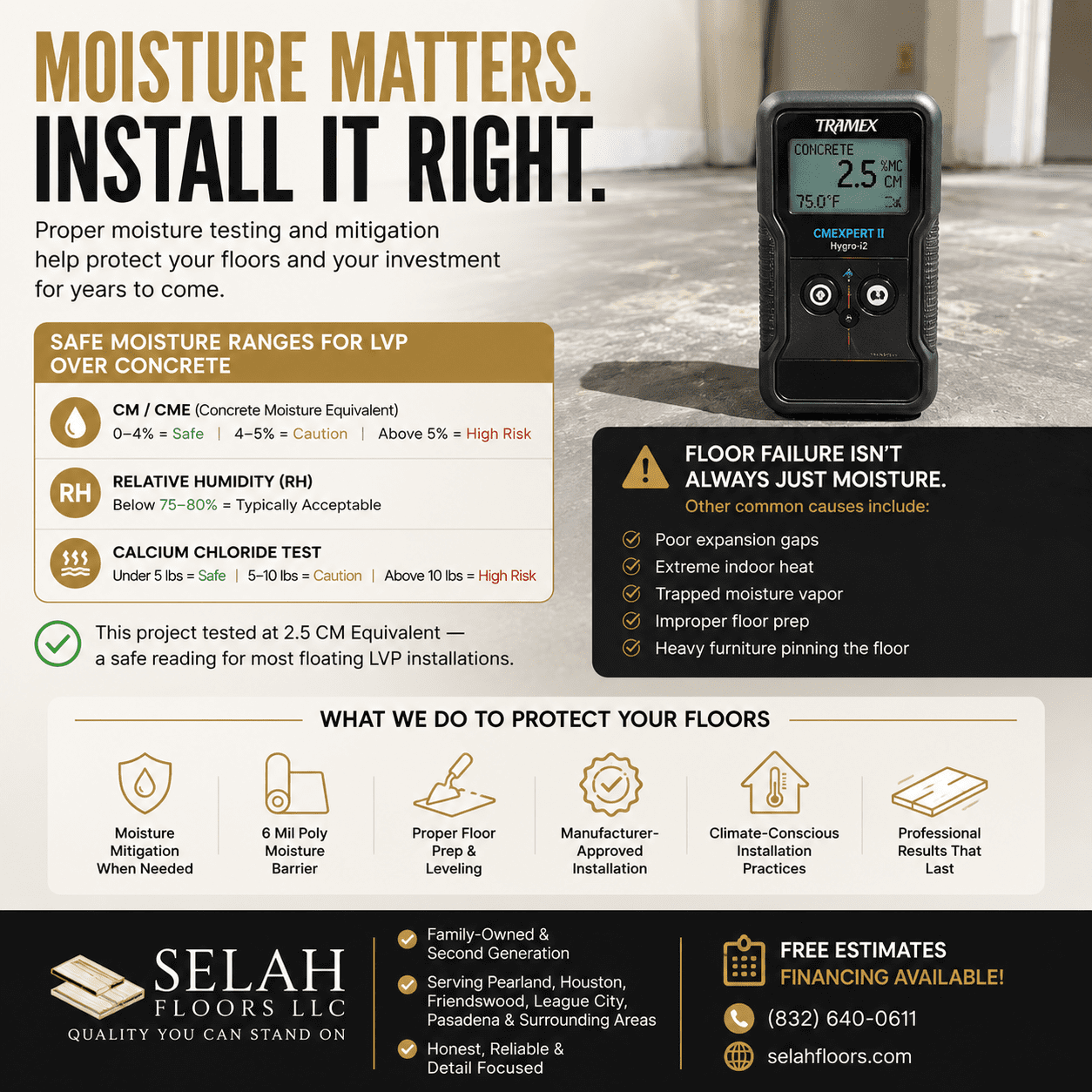
For many Luxury Vinyl Plank (LVP) flooring installations over concrete, manufacturers often consider moisture readings under 4% CM equivalent to be within an acceptable range. Recently, we tested a concrete slab using a Tramex CME Xpert II moisture meter and received a reading of 2.5 CM equivalent — a level that is typically considered acceptable for many floating LVP flooring systems.
However, one of the biggest misconceptions in the flooring industry is that moisture is always the only reason floors fail.
The reality is that floor movement, buckling, peaking, and separation can happen even when moisture readings appear acceptable. Over the years, we’ve seen flooring problems caused by several installation and environmental factors working together.
Some common causes of flooring failure can include:
✔️ Poor or insufficient expansion gaps
✔️ Extreme indoor temperatures or excessive heat
✔️ Trapped moisture vapor beneath the floor
✔️ Improper subfloor preparation
✔️ Uneven concrete slabs
✔️ Heavy furniture restricting natural floor movement
✔️ Incorrect installation methods
✔️ Lack of moisture mitigation protection
For this particular project, we also performed additional moisture mitigation measures to help reduce long-term moisture-related risks before installation. In some situations, especially in areas like Houston and Pearland where humidity and slab conditions can fluctuate, taking extra precautions can make a major difference in the long-term performance of the floor.
At Selah Floors LLC, we believe proper flooring installation is about much more than simply laying planks down. We focus on preparing the surface correctly, evaluating moisture conditions, and following manufacturer-approved installation methods designed for durability and long-term performance.
Depending on the project, we may recommend:
• Moisture mitigation systems
• 6 mil poly moisture barriers
• Proper floor prep and leveling
• Expansion spacing guidelines
• Manufacturer-approved underlayment’s
• Climate-conscious installation practices
Every home and every slab condition is different. That’s why proper evaluation, preparation, and installation matter just as much as the flooring product itself. Our goal is not only to install beautiful floors, but to help homeowners protect their investment for years to come.